Institutional Effectiveness & Assessment
Overview
Quincy College connects institutional effectiveness and academic assessment through a shared commitment to evidence-informed continuous improvement. Strategic planning, institutional data, assessment of student learning, program review, and annual planning provide evidence used to strengthen programs, services, student learning, and institutional decision-making.
Institutional Effectiveness
How Quincy College connects mission, strategy, institutional evidence, team-based goals, results, and reassessment to advance institutional priorities and student success.
General Education Assessment
How faculty assess shared institutional student learning outcomes, use direct evidence of student learning, take action based on findings, and reassess to support continuous improvement.
Program Assessment
How academic programs use Planned Student Learning Assessment and Responsive Evidence to evaluate program effectiveness, strengthen student learning, and close the loop through action and follow-up.
Evidence → Action → Results → Reassessment
Institutional Effectiveness
Quincy College uses an integrated, mission-driven approach to institutional effectiveness that connects strategic planning, annual goal setting, institutional research, assessment, shared responsibility, governance, and continuous improvement.
The purpose of institutional effectiveness is to ensure that the College’s mission and strategic priorities move from planning to implementation, evidence, assessment, and action. Results inform what should be maintained, revised, expanded, or addressed in subsequent planning cycles.
From Mission to Results
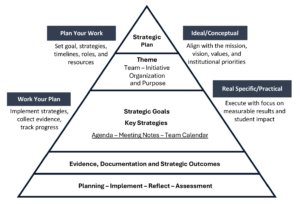
Quincy College’s Institutional Effectiveness Framework illustrates how the College connects its mission and Strategic Plan with institutional teams, annual goals, implementation, evidence, reflection, assessment, and institutional outcomes.
Strategic Direction
The 2026–2028 Strategic Plan establishes six Strategic Themes that guide institutional planning:
- Program Development
- Educational Access
- Student Success
- High-Quality Teaching, Learning & Academic Excellence
- Human, Information & Capital Resources
- Financial Stability & Resource Development
Institutional and operational teams translate these priorities into annual goals, strategies, timelines, responsibilities, success measures, and sources of evidence.
Strategic Theme → Institutional Priority → Team Goal → Strategy → Evidence → Result
A Team-Based Organization Approach
Institutional effectiveness is shared work. Cross-divisional teams bring together faculty, staff, administrators, and leadership to implement institutional priorities, examine evidence, coordinate action, and evaluate progress.
Leadership, governance, Institutional Research and Effectiveness, and College advisory structures provide additional monitoring and oversight.
Evidence & Monitoring
Quincy College uses multiple forms of evidence to understand institutional performance and guide improvement. Evidence may include institutional KPIs and dashboards, enrollment and retention, graduation and transfer, student success, student learning assessment, program review, financial performance, licensure and certification, workforce and advisory input, surveys, and operational measures.
Evidence helps the College answer three questions:
- What did we intend to accomplish?
- What does the evidence show?
- What should we do next?
Continuous Improvement
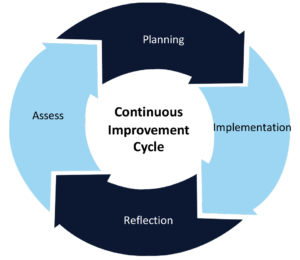
Quincy College uses a recurring cycle:
Planning → Implementation → Reflection → Assessment → Next Action → Planning
| Planning | Implementation | Reflection | Assessment |
|---|---|---|---|
| Establishes the intended result and how progress will be measured | Puts strategies into practice and documents evidence | Examines results, strengths, challenges, and emerging needs | Determines what was accomplished and what should happen next |
Institutional Outcomes
Institutional effectiveness ultimately examines whether the College’s planning and actions are advancing its mission and supporting student success.
- Enrollment & Retention
- Graduation & Transfer
- Student Success
- Program Outcomes
- Workforce Readiness
- Strategic Goal Achievement
- Financial Health
Explore Assessment & Institutional Resources – Link
2026–2028 Strategic Plan
Institutional Data & Fact Book
General Education Assessment
Program Assessment
Accreditation & NECHE
General Education Assessment
Then General Education Assessment examines student achievement of learning outcomes that extend across programs and provide an institution-wide view of student learning.
Faculty participate in identifying and assessing student work, interpreting results, identifying strengths and areas for improvement, and using findings to strengthen teaching, curriculum, and student learning.
General Education Assessment is part of Quincy College’s broader commitment to evidence-informed continuous improvement:
Student Learning Outcomes → Evidence of Learning → Faculty Review → Action → Reassessment
General Education Learning Outcomes
Quincy College has established six General Education Outcomes that describe the knowledge and skills students are expected to develop through their educational experience.
- Communicate thoughts in a coherent, unified, and well-structured manner.
- Demonstrate technology and computer literacy skills.
- Use mathematical reasoning and the scientific method to draw logical conclusions from qualitative and quantitative data.
- Identify and synthesize information from credible sources.
- Analyze the relationship of oneself to a diverse society, both locally and globally.
- Apply ethical, critical, and creative thinking in all practices.
How General Education Assessment Works
General Education outcomes are assessed on a recurring cycle using direct evidence of student learning. Depending on the outcome, evidence may include embedded course assignments, common assessment instruments, student writing, projects, applied activities, and common rubrics.
Faculty contribute to the process by identifying appropriate student work, applying common assessment criteria, participating in calibration when appropriate, reviewing findings, and determining what the evidence suggests about student learning.
Curriculum mapping also helps identify where General Education outcomes are introduced, reinforced, and demonstrated across the curriculum, strengthening the connection between assessment and the courses in which students develop these competencies.
From Evidence to Improvement
General Education Assessment does not end when student work is scored or a report is completed.
Faculty and the Assessment Committee review findings to identify strengths, areas for improvement, and appropriate next actions. Responses may include changes to instruction, assignments, curriculum alignment, assessment instruments, rubrics, faculty development, or the assessment process itself.
Subsequent assessment allows the College to determine what happened after those actions and whether additional improvement is needed.
Closing the Loop: General Education Assessment
Multi-year assessment provides evidence of how findings have informed subsequent assessment, curriculum alignment, faculty practice, and continued areas for improvement.
| General Education Outcome | Evidence & Closing the Loop | Status |
|---|---|---|
| GEO #1 Communication |
Earlier assessment identified Sources & Evidence as an area for improvement. The 2024–2025 reassessment used embedded assignments, a common rubric, faculty calibration, and a substantially larger evidence base. Sources & Evidence remained the lowest combined criterion, confirming an area for continued instructional attention. | Continued Improvement |
| GEO #2 Technology & Computer Literacy |
Assessment findings contributed to recommendations for stronger curriculum alignment and I-R-M mapping, supporting more intentional, course-aligned General Education assessment. | Action/Follow-Up |
| GEO #3 Data Literacy |
Participation increased from 22 students to 113 students in 2021–2022 and to 372 students in the 2025–2026 reassessment. The reassessment identified a new area for improvement involving more complex reasoning with data. | Reassessed/New Action |
| GEO #4 Information Literacy |
Earlier assessment informed improvements in assessment design and alignment. Reassessment is underway in 2026–2027 using curriculum mapping and a common rubric. | Reassessment in Progress |
| GEO #5 Self & Society |
Findings informed continued alignment of General Education outcomes, assignments, and assessment practices and contribute to subsequent curriculum-mapping and assessment work. | Follow-Up |
| GEO #6 Critical, Ethical & Creative Thinking |
Embedded student work, Faculty Ambassadors, a common rubric, and faculty calibration strengthened faculty-engaged assessment practice and informed subsequent General Education assessment. | Action/Follow-Up |
Closing the loop is an ongoing process. Some assessment cycles result in immediate instructional or assessment changes, while others establish evidence that is carried forward into curriculum mapping, subsequent assessment, or reassessment. The College documents both completed improvement cycles and areas where follow-up remains in progress.
Evidence → Findings → Faculty Action → Follow-Up → Reassessment
Explore General Education Assessment – looking for to link
General Education Learning Outcomes
Current Assessment
Assessment Reports & Results
Curriculum Mapping
Program Assessment
Program assessment is a faculty-led process for understanding student learning and strengthening academic programs through evidence-informed continuous improvement.
Quincy College uses two complementary methods of program assessment: Planned Student Learning Assessment and Responsive Evidence. These methods begin with different types of evidence but lead to the same continuous-improvement process.
Evidence → Faculty Review → Action → Follow-Up → Reassessment
Programs use findings to maintain successful practices, strengthen curriculum and instruction, revise assignments or assessment methods, improve student support, respond to changes in the discipline or workforce, and determine what should be examined next.
Two Methods of Program Assessment
| Method | Where Assessment Begins | Examples of Evidence | Purpose |
|---|---|---|---|
| 1. Planned Student Learning Assessment | A Program Learning Outcome (PLO) selected for direct assessment | Key/signature assignments, examinations, projects, presentations, capstones, laboratory practicals, clinical evaluations, common rubrics, and other direct student work | Determine how well students are achieving a PLO and identify opportunities to strengthen student learning |
| 2. Responsive Evidence | Meaningful evidence or an emerging question about program effectiveness | Program review, enrollment and progression, completion, licensure/certification, accreditation, advisory-board or employer feedback, workforce trends, modality, student/faculty feedback, curriculum alignment, technology, resources, or other program evidence | Respond to evidence affecting program quality, currency, access, effectiveness, or student success |
Responsive Evidence complements, but does not replace, direct assessment of student learning. Together, the two methods provide a broader understanding of student achievement and program effectiveness.
Method 1: Planned Student Learning Assessment
Planned Student Learning Assessment begins with the program’s established Program Learning Outcomes (PLOs).
Faculty identify where students demonstrate a selected outcome, collect direct evidence of learning, apply common criteria or benchmarks when appropriate, and analyze the results.
The process generally includes:
PLO → Curriculum Alignment → Direct Evidence → Analysis → Faculty Interpretation → Action → Reassessment
Assessment methods vary by discipline. Programs may use embedded course assignments, common or signature assignments, capstone projects, examinations, presentations, laboratory practicals, clinical evaluations, common rubrics, and other authentic measures appropriate to the field.
Curriculum mapping helps faculty identify where learning outcomes are introduced, reinforced, and demonstrated and where meaningful program-level assessment should occur.
Method 2: Responsive Evidence
Not every important program improvement begins with a scheduled PLO assessment.
Responsive Evidence allows programs to act when other meaningful evidence identifies a question, need, strength, or opportunity related to program effectiveness.
Evidence may come from program review, enrollment and progression, completion, licensure and certification, accreditation, advisory boards and employers, workforce trends, modality and access, curriculum review, student or faculty feedback, technology, facilities, equipment, or other program-specific evidence.
Faculty consider what the evidence means, determine an appropriate response, and identify what evidence should be examined afterward.
The process is:
- Evidence/Need → Faculty Interpretation → Action → Follow-Up Evidence → Next Decision
Program Assessment in Practice at Quincy College
The examples below illustrate how programs apply one or both assessment methods. Because programs are at different points in their assessment cycles, examples may represent completed reassessment, an action in progress, or a next step identified for follow-up.
| Program | Assessment Evidence | Method | Action/Closing the Loop |
|---|---|---|---|
| Biology & Natural Science | Common scientific-reasoning assessment in introductory Chemistry and advanced Microbiology | Planned Student Learning | Advanced students generally demonstrated stronger performance. Faculty are continuing the common assessment to examine progression over time and strengthen longitudinal evidence. |
| Biology & Natural Science | Laboratory and program-review evidence identified opportunities involving laboratory experiences and advanced instrumentation | Responsive Evidence | Laboratory activities and learning experiences were strengthened, with continued attention to equipment, access, and applied scientific learning. |
| Computer Science – Programming | Pre/post assessments and programming-sequence evidence identified below-threshold performance | Planned Student Learning | Faculty revised the programming sequence to use C++ consistently and redistributed course content; subsequent cohorts continue to be assessed to determine the effect of the changes. |
| Cyber Security | Direct assessment identified concerns with Linux file/log analysis and student readiness | Planned Student Learning leading to Responsive Action | Faculty identified prerequisite/readiness as a question for improvement and will reassess after the selected intervention. |
| Physical Therapist Assistant | SOAP notes, case studies, clinical measures, licensure and progression evidence | Planned + Responsive Evidence | Faculty use student-learning and professional-program evidence together to monitor competency, progression, retention, and program effectiveness. |
| Surgical Technology | Capstone and clinical competency evidence | Planned Student Learning | Students met the established capstone benchmark. Faculty maintain successful practices while continuing to monitor clinical and certification outcomes. |
| Criminal Justice | PLO assessment combined with program review, enrollment, advisory, workforce, curriculum, and modality evidence | Both Methods | Evidence contributed to curriculum and PLO remapping, program restructuring, General Education alignment, textbook modernization, and continued evaluation of delivery options. |
Program Assessment and Program Review
Annual Program Assessment and periodic Program Review are complementary components of continuous improvement.
Program Assessment examines student learning and other meaningful program evidence to identify strengths, needs, actions, and follow-up.
Program Review provides a broader, periodic examination of program quality, currency, effectiveness, and sustainability using multiple years and types of evidence.
Findings from either process may identify opportunities for improvement and inform subsequent assessment, planning, curriculum development, or resource decisions.
That’s enough. You don’t need the larger comparison table.
Using Results for Improvement
Program assessment does not end when data are collected or a report is completed.
Faculty review findings and determine the appropriate next action. Depending on the evidence, programs may:
- Maintain a successful practice
- Revise curriculum or instruction
- Modify an assignment or rubric
- Change course sequencing or prerequisites
- Strengthen student support
- Improve clinical or laboratory experiences
- Address differences across modalities
- Update technology or resources
- Gather additional evidence
- Reassess
Importantly, closing the loop does not require every assessment to identify a deficiency. When students meet or exceed expectations, faculty may determine that an effective practice should be maintained and monitored.
When change is needed, follow-up evidence helps determine whether the action produced the intended result.
Assess → Interpret → Act → Follow Up → Reassess
Strengthening Program Assessment
Quincy College continues to strengthen program assessment through greater use of repeatable key/signature assignments, common assessment criteria, curriculum mapping, faculty review of results, and longitudinal evidence.
This work builds upon existing assessment practices by strengthening the College’s ability to demonstrate a clear multi-year progression: