Accreditation
Institutional Accreditation
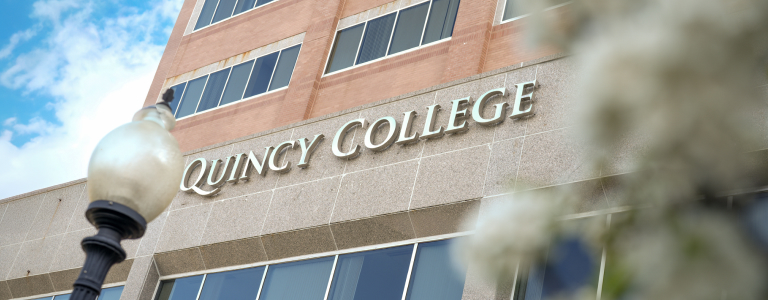
Quincy College is accredited by the New England Commission of Higher Education (NECHE), an institutional accreditor recognized by the U.S. Department of Education. Accreditation by NECHE indicates that an institution meets established standards for institutional quality and demonstrates its commitment to educational effectiveness and continuous improvement. NECHE accreditation applies to Quincy College as a whole.
New England Commission of Higher Education (NECHE)
301 Edgewater Place, Suite 210
Wakefield, MA 01880
781-425-7785
Massachusetts Degree-Granting Authorization
Quincy College is authorized by the Massachusetts Board of Higher Education to award degrees and certificates in accordance with its degree-granting authority and applicable Massachusetts requirements.
Quincy College’s baccalaureate authority is also subject to Massachusetts Board of Higher Education review and approval. Massachusetts documentation confirms that Quincy College was authorized by statute in 2017 to grant baccalaureate degrees, subject to BHE review and approval of those degrees.
Massachusetts Department of Higher Education
Programmatic Accreditation and Approval
In addition to institutional accreditation, certain Quincy College academic programs hold specialized accreditation or approval, candidacy, or applicant status with appropriate accrediting and regulatory bodies.
Surgical Technology – CAAHEP
The Quincy College Surgical Technology Program is accredited by the Commission on Accreditation of Allied Health Education Programs (CAAHEP) upon the recommendation of the Accreditation Review Council on Education in Surgical Technology and Surgical Assisting (ARC/STSA). Quincy College’s current Surgical Technology page confirms this accreditation.
Commission on Accreditation of Allied Health Education Programs (CAAHEP)
25400 US Highway 19 North, Suite 158 Clearwater, FL 33763
727-210-2350
Physical Therapist Assistant – CAPTE
The Physical Therapist Assistant Program at Quincy College is accredited by the Commission on Accreditation in Physical Therapy Education (CAPTE).
Commission on Accreditation in Physical Therapy Education (CAPTE)
3030 Potomac Ave., Suite 100 Alexandria, VA 22305-3085
703-706-3245
Email: [email protected]
Associate Degree in Nursing – BORN Approval and ACEN Accreditation
The Quincy College Associate of Science Degree in Nursing (ASN) program has full approval granted by the Massachusetts Board of Registered Nursing (MABORN). For more information, contact Massachusetts Department of Public Health, Board of Registration in Nursing (MABORN) on the web at www.mass.gov/dph/boards or at 100 Cambridge Street, 19th floor, Boston, MA 021114-2509 or by phone (800) 414-0168 or Alt. (617) 973-0900.
The associate nursing program at Quincy College is accredited by the:
Accreditation Commission for Education in Nursing (ACEN)
3390 Peachtree Road NE, Suite 1400 Atlanta, GA 30326
The most recent accreditation decision made by the ACEN Board of Commissioners for the associate nursing program is initial accreditation.
View the public information disclosed by the ACEN regarding this program on the ACEN website: Quincy College Associate.
Initial accreditation is effective February 19, 2025, with the next evaluation visit scheduled for Spring 2031.
Practical Nursing – BORN Approval and ACEN Candidacy
The Quincy College Practical Nursing Certificate program (PN) program has full approval granted by the Massachusetts Board of Registered Nursing (MABORN). For more information, contact Massachusetts Department of Public Health, Board of Registration in Nursing (MABORN) on the web at www.mass.gov/dph/boards or at 100 Cambridge. Street, 19th floor, Boston, MA 021114-2509 or by phone (800) 414-0168 or Alt. (617) 973-0900.
Accreditation Commission for Education in Nursing (ACEN)
3390 Peachtree Road NE, Suite 1400 Atlanta, GA 30326
The most recent accreditation decision made by the ACEN Board of Commissioners for the practical nursing program is initial accreditation.
View the public information disclosed by the ACEN regarding this program on the ACEN website: Quincy College Practical.
Initial accreditation is effective February 19, 2025, with the next evaluation visit scheduled for Spring 2031.
Radiologic Technology
The radiography program is accredited by the Joint Review Committee on Education in Radiologic Technology.
Joint Review Committee on Education in Radiologic Technology (JRCERT)
20 N. Wacker Drive, Suite 2850
Chicago, IL 60606-3182
312-704-5300
[email protected]
The program’s current award is 3 years.
General program accreditation information and the current accreditation award letter can be found www.jrcert.org/programs/quincy-college
NECHE Accreditation and Comprehensive Evaluation
Quincy College is accredited by the New England Commission of Higher Education (NECHE). As part of the College’s ongoing accreditation cycle, Quincy College will host a comprehensive evaluation team from October 25–28, 2026. The comprehensive evaluation provides an opportunity for Quincy College to reflect on institutional effectiveness, educational quality, student success, and continuous improvement in relation to the NECHE Standards for Accreditation.
About NECHE
The New England Commission of Higher Education (NECHE) is the institutional accreditor for colleges and universities throughout New England and also accredits institutions elsewhere in the United States and internationally. Through accreditation and peer review, NECHE provides public assurance of the educational quality and institutional capacity of its member institutions.
2026 NECHE Standards for Accreditation
NECHE’s 2026 Standards for Accreditation took effect July 1, 2026. The revised framework organizes institutional accreditation around five Standards addressing mission and governance, academic quality, institutional resources, educational effectiveness and student success, and integrity and public accountability.
View the 2026 NECHE Standards for Accreditation
Quincy College Self-Study
Beginning in 2024, Quincy College undertook a comprehensive institutional self-study involving faculty, staff, administrators, students, institutional leadership, and the Board of Governors.
The self-study evaluates Quincy College’s progress, strengths, challenges, and priorities in relation to the five 2026 NECHE Standards for Accreditation. The Standards below provide members of the evaluation team and the College community with a clear overview of the areas addressed throughout the self-study and comprehensive evaluation.
- Standard 1 – Mission, Organization, Governance, and Planning
- Standard 2 – The Academic Program, Faculty, and Students
- Standard 3 – Institutional Resources
- Standard 4 – Educational Effectiveness and the Success of All Students
- Standard 5 – Integrity, Transparency, and Public Disclosure
The final self-study reflects the College’s commitment to institutional accountability, evidence-based decision making, educational quality, and continuous improvement.
View the 2026 Quincy College Self-Study
Comprehensive Evaluation Visit: October 25–28, 2026
A team of peer evaluators appointed by NECHE will visit Quincy College to review the self-study and supporting evidence and to meet with members of the College community.
During the visit, evaluators will engage with:
- Students
- Faculty
- Staff
- College leadership
- Board of Governors
- Academic and student support areas
- Institutional planning and assessment representatives
A team of peer evaluators appointed by NECHE will visit Quincy College to review the self-study and supporting evidence and to meet with members of the College community.
During the visit, evaluators will engage with students, faculty, staff, College leadership, members of the Board of Governors, and representatives from academic programs, student support services, institutional planning, assessment, and other areas of the College.
Institutional Accreditation Information
Accreditor: New England Commission of Higher Education
Institution: Quincy College
Evaluation: Comprehensive Evaluation
Visit Dates: October 25–28, 2026
Commission Review: Spring 2027
College Accreditation Contact: Karen Manning, Vice President of Academic Affairs, Quincy College
Accreditation Timeline
- Spring 2024: Self-study planning begins
- February 2025: College-wide self-study launch
- 2025–2026: Evidence collection, analysis, and drafting
-
July 1, 2026: New NECHE Standards for Accreditation take effect
-
September 2026: Final Self-Study submitted to NECHE
- October 25–28, 2026: Comprehensive Evaluation Visit
- Spring 2027: NECHE Commission Review
Invitation for Public Comment
Quincy College will undergo a comprehensive evaluation by the New England Commission of Higher Education (NECHE) on October 25–28, 2026.
As part of the comprehensive evaluation process, NECHE invites members of the public to submit comments regarding Quincy College.
Public comments must address substantive matters related to the quality of the institution or its academic programs. NECHE’s public-comment process is not intended to resolve individual disputes between individuals and institutions.
Comments must include the commenter’s name and contact information, along with permission to forward the comment to the President of Quincy College. Anonymous comments will not be accepted.
Public Comment Deadline: October 28, 2026
NECHE currently lists October 28, 2026, as the public-comment deadline for Quincy College.
Comments should be submitted directly to:
Public Comment on Quincy College
New England Commission of Higher Education
301 Edgewater Place, Suite 210
Wakefield, MA 01880
Email: [email protected]
NECHE Public Comments Policy & Information
NECHE Upcoming Evaluations and Public Comment Deadlines
Assessment Resources
Student Learning Outcomes Assessment may seem daunting, but the truth is that there are many effective ways to assess student learning. The most important thing to remember is that not all assessments are the same – and they should not be! Assessments should be true to do the discipline for which they are meant to assess. For example, it may be difficult to assess a student’s writing ability with a math problem, just as it may be difficult to assess a math problem with an essay and a rubric.
The resources here include articles around what assessment is, how assessment changes based on the discipline, definitions of commonly used assessment terms, and guides on how to choose an assessment that is right for you – at your college, in your academic division, in your field, with your students.
General Assessment Information
- UCLA | Guidelines for Developing & Assessing Student Learning Outcomes
- Definitions of Common Assessment Words and Phrases
- Course-Based Review and Assessment
Assessment Methods
Helpful Links
- American College Personnel Association (ACPA) Commission on Assessment & Evaluation
- Association of American Colleges & Universities (AACU) VALUE Rubrics
- Brown University’s Sheridan Center for Teaching and Learning
- NAPSA: Student Affairs Administrators in Higher Education
- National Institute for Learning Outcomes Assessment
- Wabash College Center of Inquiry
Additional Links for Creating Rubrics and Assessment Instruments
- California State University
- Carlton College – Assessment Workshops from the National Association of Geoscience Teachers | Tools and Instruments
- Carlton College – Assessment Workshops from the National Association of Geoscience Teachers | Tools
- Cornell University – Center for Teaching Innovation
- St. Olaf College – Institutional Research and Effectiveness
- University of West Florida – Center for University Teaching, Learning, and Assessment