Radiation Therapy

Overview
The program prepares students for entry-level practice as radiation therapists and eligibility to pursue national certification through the American Registry of Radiologic Technologists (ARRT). The curriculum integrates classroom, online, and hybrid instruction with progressive, competency-based clinical education to develop the knowledge, technical skills, critical-thinking abilities, communication skills, and professional behaviors required for safe and effective radiation therapy practice.
Students receive instruction in patient care, imaging, radiation physics and radiation protection, radiobiology, radiation oncology, treatment planning, quality assurance, and radiation therapy treatment techniques. Through supervised clinical education, students progressively apply knowledge and develop competency in simulation, patient positioning and immobilization, imaging and treatment verification, treatment delivery, radiation safety, patient care, and professional practice. Graduates are prepared to demonstrate entry-level clinical competence and provide safe, compassionate, patient-centered care as members of the interdisciplinary radiation oncology team.
Program Outcomes
Upon successful completion of this program, students will be able to:
- Perform radiation therapy treatment and simulation procedures safely and accurately in accordance with prescribed treatment plans and professional standards.
- Demonstrate clinical competence in patient care, positioning, immobilization, imaging, treatment verification, and radiation therapy treatment delivery.
- Communicate effectively and professionally with patients, families, and members of the interdisciplinary healthcare team.
- Demonstrate effective written, electronic, and verbal communication using appropriate medical and radiation oncology terminology and documentation practices.
- Apply critical-thinking and problem-solving skills to patient care, simulation, imaging, treatment planning, treatment delivery, and clinical practice.
- Analyze treatment planning, imaging, treatment verification, and quality assurance information to determine appropriate actions and support safe and accurate radiation therapy practice.
- Provide compassionate, patient-centered care that addresses patients’ physical and psychosocial needs while applying radiation protection and safety principles.
- Demonstrate ethical, legal, accountable, and professional behavior consistent with patient-centered care and the standards of radiation therapy practice.
Radiation Therapy Courses
-
Code
Course
Credits
-
- MAT 103
College Algebra
- 3
-
- BIO 131
Anatomy & Physiology I w/ Lab
- 4
-
- BIO 132
Anatomy & Physiology II w/ Lab
- 4
-
- ENG 101
English Composition I
- 3
-
- ENG 102
English Composition II
- 3
-
- PSY 101
General Psychology
- 3

Start your education at Quincy College. Our online and blended curriculum makes it easy for you to earn your degree!

You might also be interested in...
-
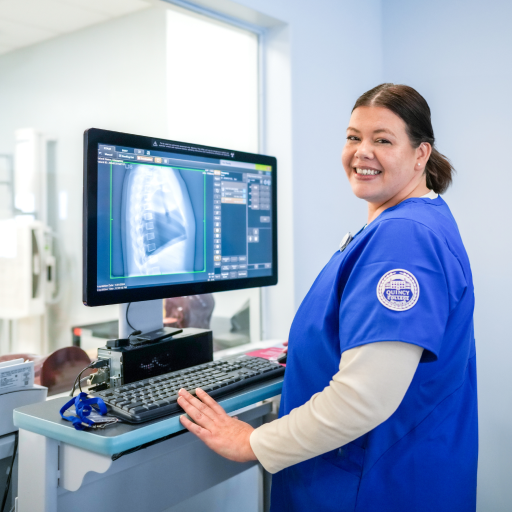
Radiologic Technology
Get hands-on imaging training and prepare for ARRT certification and licensure in Massachusetts in the radiologic technologist program.
-

Nursing (RN)
Quincy College’s Associate in Science Degree in Nursing program is a blended, Nurse of the Future competencies and concept-based curriculum.
-

Nursing (LPN)
Become an LPN in 10 months with Quincy College’s accredited Practical Nursing (LPN) program, which offers clinical experience and comprehensive LPN ed
-

Physical Therapist Assistant (PTA) | Associate Degree
The Physical Therapist Assistant Program at Quincy College prepares students for licensure and employment as a PTA. PTA School